The Latest Data on For-Profit Colleges and the Future of Workforce Readiness
By Riley Burr, Director of Policy and Research, Career Education Colleges and Universities (CECU)
The role of for-profit colleges in American higher education has faced debate in the past, with critics citing high costs and past regulatory concerns while advocates point to their flexible, career-focused programs that serve nontraditional learners. Lightcast recently released Talent Shortages and Student Outcomes, a report commissioned by the CECU Research Foundation that challenges outdated assumptions about for-profit institutions and affirms their crucial role in addressing national talent shortages and delivering strong student outcomes.
Lightcast draws on the latest longitudinal data and labor market analytics to examine how for-profit institutions stack up against their public and nonprofit peers. The conclusions are clear: for-profit colleges not only outperform in key student success metrics but also serve as an essential pipeline into high-demand industries. The report calls for consideration of the strengths of for-profit colleges and a reexamination of the role of these institutions in the postsecondary landscape.
Who For-Proft Institutions Serve
The student bodies at for-profit institutions are distinct in ways that speak to the sector’s unique impact. Compared to their public and nonprofit counterparts, for-profit institutions enroll higher percentages of adult learners, students of color, and women.
- At four-year for-profit institutions, 72% of students are age 25 or older, compared to just 23% at nonprofit institutions and 16% at public institutions.
- For-profit institutions enroll disproportionate shares of Black and Hispanic students, especially at the certificate and associate levels.
- Women are the majority population in all sectors of higher education, but for-profit colleges enrolled a greater percentage of women at all levels.
These demographic differences matter. For-profit colleges offer flexible, career-oriented pathways that reflect the needs of the students they serve, and the data shows that those pathways are working. For example, part-time retention rates are higher at for-profit two-year institutions than at any other sector, showing their effective support for students with significant outside responsibilities. Additionally, for-profit institutions had the lowest transfer-out rate compared to their public and nonprofit peers at both the two-year and four-year levels.
Talent Shortages
Lightcast first analyzes the current workforce contributions of the for-profit sector and how workforce demand would be affected by mass closures. Currently, for-profit institutions confer credentials that are heavily concentrated in short-and medium-term workforce training. In terms of quantity, “for-profit two-year and less-than-two-year institutions together awarded more than 250,000 certificates, including nearly 139,000 in programs lasting less than two years. For-profit four-year colleges awarded more than 99,000 bachelor’s degrees and 63,600 master’s degrees, in addition to nearly 33,000 certificates and over 40,000 associate degrees.” Many of these credentials are aligned with areas of workforce need, including allied health, skilled trades, business, and information technology.
What would the workforce look like without these for-profit credentials? Lightcast answers that question by modeling the potential impact on the U.S. workforce if there were to be a 50% reduction in for-profit college enrollment. Their analysis is rooted in the trends of how students have previously responded to for-profit school closures and found that a 50% reduction would result in a significant drop in talent supply across numerous critical occupations.
At the associate degree level, for-profit institutions currently confer:
- 50% of degrees in practical nursing, vocational nursing and nursing assistants
- 25% of degrees in allied health diagnostic, intervention, and treatment professions
- 20% of degrees in vehicle maintenance and repair technologies/technicians
- 16% of degrees in registered nursing, nursing administration, nursing research and clinical nursing
At the bachelor’s level, for-profit institutions currently confer:
- 21% of degrees in registered nursing
- 12% of degrees in business administration, management, and operations
- 10% of degrees for computer support specialists
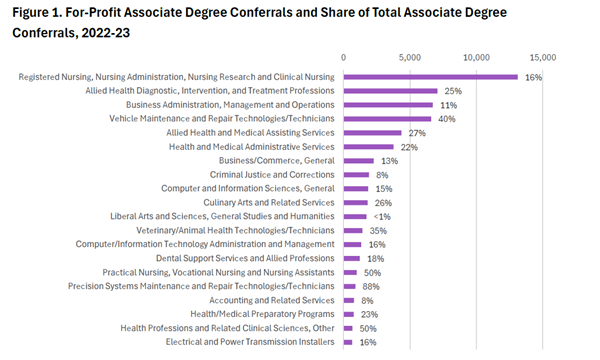
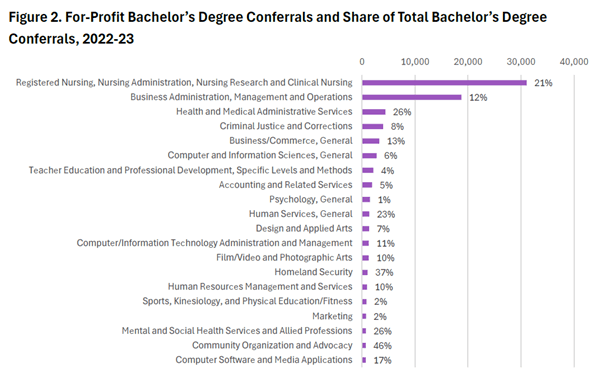
These numbers indicate for-profit institutions’ significant contributions to the workforce, making the for-profit sector a key source of talent. For example, at the associate’s level, for-profit institutions meet 11% of demand for registered nurses, 33% of demand for radiologic technologists and technicians, and 20% of demand for automotive service technicians and mechanics. In fields already facing steep labor shortages, any reductions in workforce supply will have adverse effects on the nation’s ability to meet workforce demand. Lightcast’s modeling shows that if enrollment in for-profit associate degree programs were cut in half, the supply pipeline for registered nurses would decrease by 5.2 percentage points, for radiologic technicians by 15.6 percentage points, and for automotive service technicians by 9.2 percentage points. At the bachelor’s level, a 50% reduction in for-profit colleges would decrease the supply pipeline for registered nurses by 4.4 percentage points, a field that is already facing significant shortages.
This data suggests that weakening the for-profit sector could have significant repercussions for national workforce readiness, especially in professions that are already facing shortages.
Student Outcomes: Persistence, Completion, Employment
The Lightcast report then dives deeply into how students fare during and after their time at for-profit institutions. The results cut against conventional wisdom and show that in many areas, for-profit colleges outperform their peers, particularly at the sub-baccalaureate level.
Persistence after one year:
First-year persistence, defined as reenrollment or credential completion, was strong among students at two-year and less-than-two-year for-profit institutions. These students were found to have 1.5 times higher odds of persisting than those at public institutions. Students at four-year for-profit colleges had slightly lower odds of persisting compared to public colleges.
Attainment within 150% of Normal Completion Time
To calculate differences in credential completion, Lightcast first adjusted their model to consider a range of background and enrollment characteristics, including academic confidence, enrollment intensity, Pell Grant receipt, first-generation status, risk index, dependent status, and online enrollment. When controlling for these characteristics, they found that students at two-year and less-than-two-year institutions had 5.75 times higher odds of completing a credential compared to their peers at public and nonprofit institutions. Students who entered associate degree programs at four-year for-profit institutions also had higher odds of earning a credential (2 times higher) compared to their peers at public and nonprofit colleges.
Employment
Differences in unemployment outcomes by sector were not statistically significant at the sub-baccalaureate level. However, bachelor’s degree recipients had significantly lower odds of experiencing unemployment compared to their peers from public and nonprofit institutions. The lower likelihood of unemployment may be due in part to the strong emphasis on workforce readiness at for-profit colleges.
Furthermore, graduates from for-profit institutions had significantly higher odds of securing full-time employment among both baccalaureate and sub-baccalaureate credential holders. Bachelor’s degree recipients from for-profit institutions had approximately 1.5 times higher odds of full-time employment compared to their peers from public and nonprofit institutions. Sub-baccalaureate credential holders from for-profit colleges had approximately twice the odds of securing full-time employment.
There was also a significant difference in graduates from for-profit institutions securing employment in a field directly related to their studies. Bachelor’s degree recipients from for-profit colleges had significantly higher odds of being employed in a related field compared to graduates from nonprofit colleges. Although job satisfaction is often predicted by this job alignment with career goals, institutional sector was not found to predict job satisfaction in this study.
The data presented in this Lightcast report offers a new perspective on for-profit colleges. These schools provide high-quality education to historically underserved populations. Their programs are typically shorter, more flexible, and highly aligned with workforce needs. These unique qualities contribute to for-profit colleges’ strong student outcomes, particularly at the two-year and less-than-two-year levels. Strong student outcomes in conjunction with significant contributions to meeting workforce demand demonstrate the need for for-profit colleges in the higher education landscape.
Resources:
Lightcast. (2025, April). Talent Shortages and Student Outcomes Report.