Workforce Pell Final Rule
On May 18, 2026, the U.S. Department of Education issued the final rule implementing the Workforce Pell Grant program. Authorized by the One Big Beautiful Bill Act, the final rule extends Pell Grant eligibility to short-term, job-focused training programs of 8 to 15 weeks in duration (150 to 599 credit hours).
The final rule is substantially similar to the March 2026 proposed rule and reflects the consensus reached by the negotiating committee. Implementation may begin as early as July 1, 2026, while most states are unlikely to have a formal process for program approval in place by then.
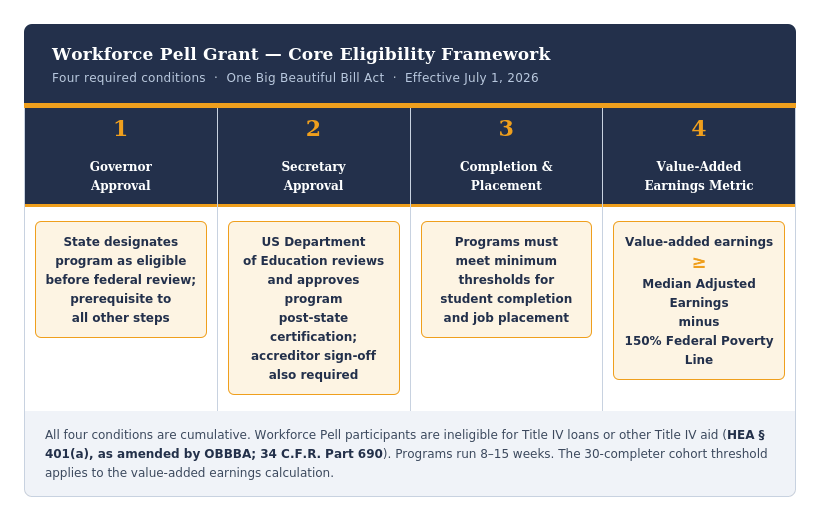
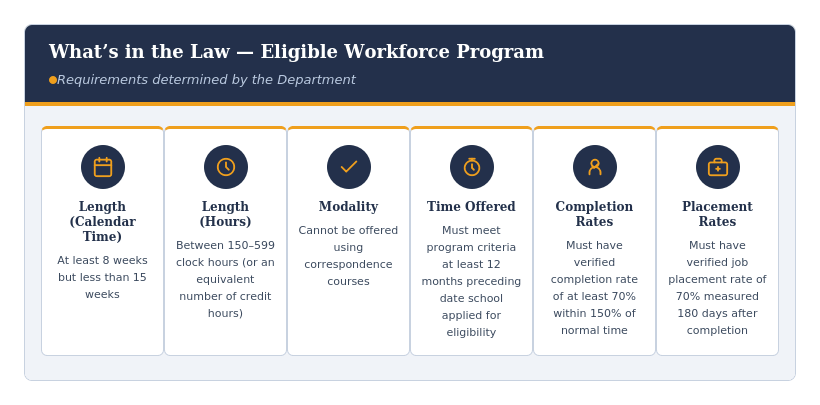
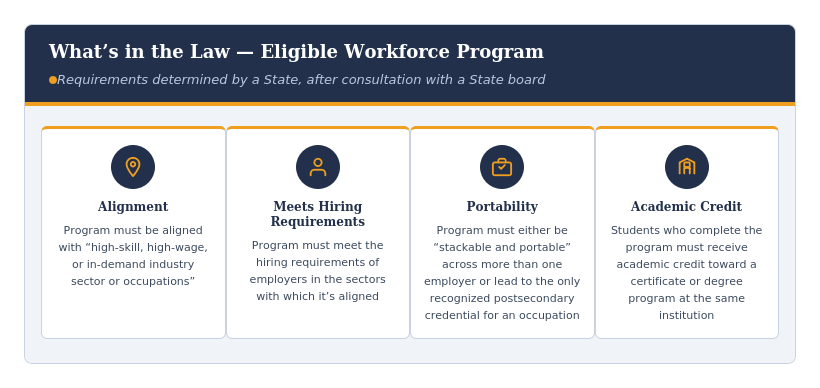
If your institution is pursuing Workforce Pell eligibility for one or more programs, the immediate priority is assessing which existing programs fall within the 8-to-15-week window and initiating the state and institutional approval processes required before a program can access Workforce Pell funds. Governor approval must precede Secretary approval, and accreditor sign-off will be required for programs at accredited institutions. While many states appear positioned to move this summer, the realistic expectation for most institutions is that fall 2026 or early 2027 is the operative implementation window.
Key Regulatory Changes from the NPRM
CECU submitted comments on the proposed rule. Three changes from the proposed rule warrant particular attention for career education institutions.
First, the Department excluded continuing students from the value-added earnings calculation. A student who completes a Workforce Pell program but remains enrolled in another educational program during the relevant earnings measurement year will not count against the earnings metric. This was a topic of back-and-forth discussion during the negotiated rulemaking because the Department initially proposed that these students would be part of the value-added earning calculation, but the law requires these programs to be “stackable” and this proposal seemed in direct conflict with the clear encouragement for students to use Workforce Pell programs as a postsecondary entry point.
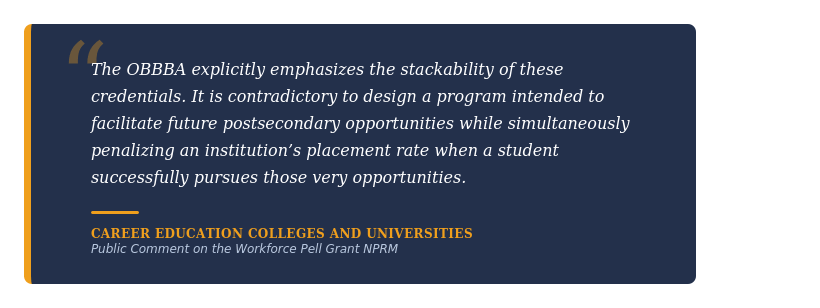
With the change in the final rule, programs that lead to longer pathways will not be penalized by the temporary earnings suppression that often accompanies continued enrollment.
Second, the Department revised the small-program cohort threshold, adopting a 30-completer minimum rather than the more complicated framework in the proposed rule. The proposed rule contemplated a program size of 50 completers before dropping to 30. A 30-completer threshold is more workable and is more often aligned with accepted thresholds for privacy suppression of data. The final rule did, however, keep the requirements to aggregate multiple cohorts until the minimum of 30-completers can be measured. It is also worth noting that this revision may signal the Department’s preferred approach to small cohorts as it develops the forthcoming “Do No Harm” final regulations.
Third, the final rule includes a targeted adjustment for apprenticeship-related instruction components. Under the proposed rule, the portion of a Workforce Pell program delivered through an ineligible third-party provider was generally capped at 25 percent.
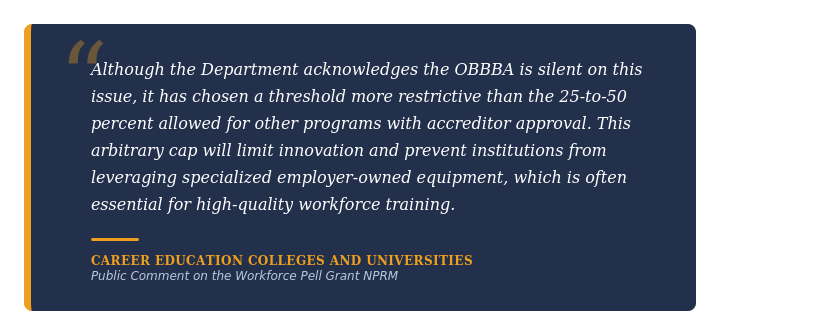
The final rule retains that cap in most circumstances but allows a larger third-party share (more than 25 percent but less than 50 percent) when the program constitutes the related instruction component of a Registered Apprenticeship. For CECU members who serve as the related instruction provider for employer- or union-sponsored apprenticeship programs, this adjustment provides more structural flexibility to formalize those partnerships within a Workforce Pell framework. That said, this is a narrow carve-out and does not constitute a general opening for unaffiliated training providers to access Workforce Pell dollars independently.
What the Department Declined to Do
Public comments included several requests for proposed rule revisions. The Department declined to create a direct participation pathway for non-Title IV training providers, declined to allow reliance on State Eligible Training Provider lists (ETPL) as a standalone qualification mechanism, declined to delay implementation, and declined to otherwise loosen the statutory guardrails Congress built into the program. These decisions are consistent with the Administration's stated commitment to accountability and reflect the political reality that Workforce Pell passed Congress in part because of its built-in performance requirements. The guardrails are not going away, and institutions should plan program development around that premise.
What's Next
CECU is monitoring state-level Governor approval activity and will continue to update members when states have formal approval processes in place.
If your school is interested in one or more programs eligible for Workforce Pell, conduct an internal audit of existing short-term programs that fall within the 8-to-15-week window and are offered in fields likely to qualify as high-demand under state and federal criteria. Review your institution's completion and placement tracking infrastructure, because the accountability metrics built into Workforce Pell are substantive gatekeepers for Workforce Pell funds.
While most states are still in the process of formalizing the state obligations in the Workforce Pell eligibility determination, some states are much further along than others. CECU members with specific Workforce Pell concerns should use CECU Communities Open Forum to send questions to CECU government affairs and CECU member experts.